

Overview
Turbidity is a key indicator of water quality, measuring the cloudiness or haziness of a fluid due to the presence of suspended particles. These particles scatter light, and the extent of scattering is quantified using different turbidity units. Understanding these units is essential for accurate monitoring and regulatory compliance in water and wastewater treatment applications.
What Is NTU in Turbidity?
NTU stands for Nephelometric Turbidity Units. It represents a measurement of light scattered at a 90-degree angle to the incident light source, typically using a nephelometer. This is the most common turbidity unit used in water treatment plants, particularly in accordance with the USEPA Method 180.1.
The higher the NTU value, the more suspended solids are present in the water. Although turbidity is different from suspended solids (SS), there is a rough correlation: 1 mg/L (or ppm) of SS ≈ 3 NTU. For example, 300 ppm of SS equates to approximately 900 NTU.
According to the World Health Organization (WHO), drinking water should not exceed 5 NTU to ensure safety and clarity.
Comparison of Turbidity Units
In addition to NTU, several other units are used to measure turbidity, depending on regional standards and instrument types:
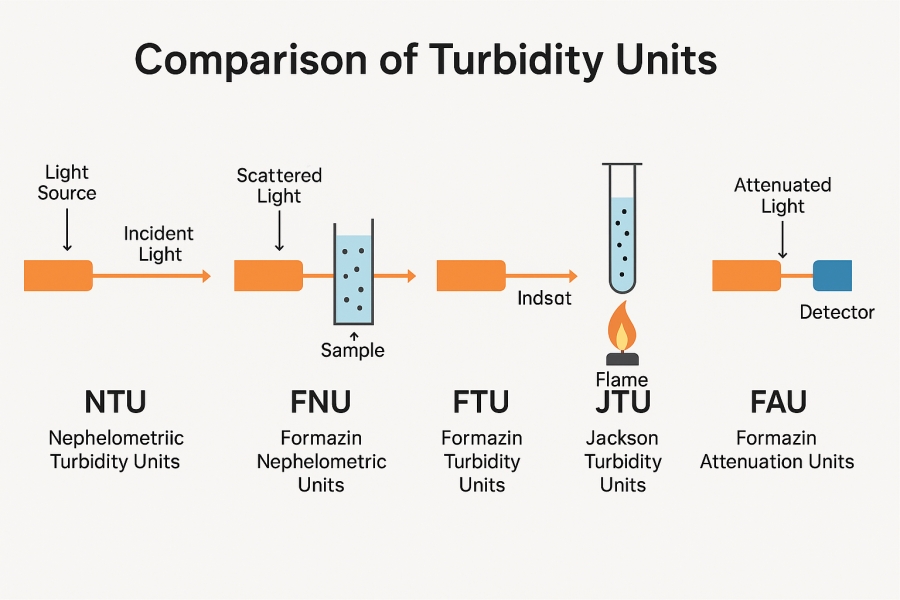
- FNU (Formazin Nephelometric Units): Used in ISO 7027 standard (European). Like NTU, it measures scattered light at 90°, but uses an infrared light source to reduce color interference.
- FTU (Formazin Turbidity Units): A general term for turbidity measurements using formazin calibration. It does not specify how light is detected, thus not tied to a specific method.
- JTU (Jackson Turbidity Units): An outdated unit based on visual measurement using the Jackson candle turbidimeter. Water is added to a tube until a candle flame is no longer visible.
- FAU (Formazin Attenuation Units): Measures light attenuation at 180°, typically using spectrophotometers or colorimeters. While based on formazin standards, it is not recognized by most regulatory agencies for turbidity compliance.
All these units are calibrated using the same formazin primary standard. However, differences in instrumentation and light sources lead to variations in measurement results on real water samples.
Which Turbidity Unit Should You Use?
The choice of turbidity unit depends on the application and compliance requirements:
- NTU: Ideal for drinking water and municipal systems following USEPA standards.
- FNU: Preferred in European markets and industrial applications compliant with ISO 7027.
- FAU and JTU: Primarily used for legacy data or research, not for modern regulatory compliance.
Daruifuno Turbidity Sensor Solutions
At Daruifuno, we design high-precision optical turbidity sensors compatible with both NTU and FNU measurement methods. Our instruments support real-time turbidity monitoring with Modbus or analog output, making them ideal for water treatment plants, industrial discharge monitoring, and environmental protection systems.
Whether you're working with clean drinking water or challenging wastewater conditions, Daruifuno's turbidity solutions ensure accuracy, compliance, and long-term reliability.
Conclusion
Understanding turbidity units is critical for choosing the right measurement method and equipment. While NTU and FNU dominate the industry today, historical units like JTU and FAU offer context but limited relevance. Trust Daruifuno’s advanced turbidity sensors to deliver precise, standards-compliant readings across all water quality applications.
