

Overview
Chemical Oxygen Demand (COD) is a key indicator of water quality, representing the amount of oxygen required to oxidize organic matter in water. Accurate and real-time monitoring of COD is essential for wastewater treatment, environmental monitoring, and industrial process control. Two widely used technologies for COD measurement are UV-Vis based COD sensors and reagent-based COD meters. This article offers a comprehensive comparison of both methods, covering detection principles, performance, and suitability for various applications.
Principles of UV-Vis and Reagent-Based COD Detection
UV-Vis COD sensors use ultraviolet and visible light absorption—typically at wavelengths around 254 nm and 436 nm—to estimate the concentration of organic compounds. The absorption intensity is directly related to the amount of dissolved organic matter in the sample, allowing for continuous, reagent-free measurement.
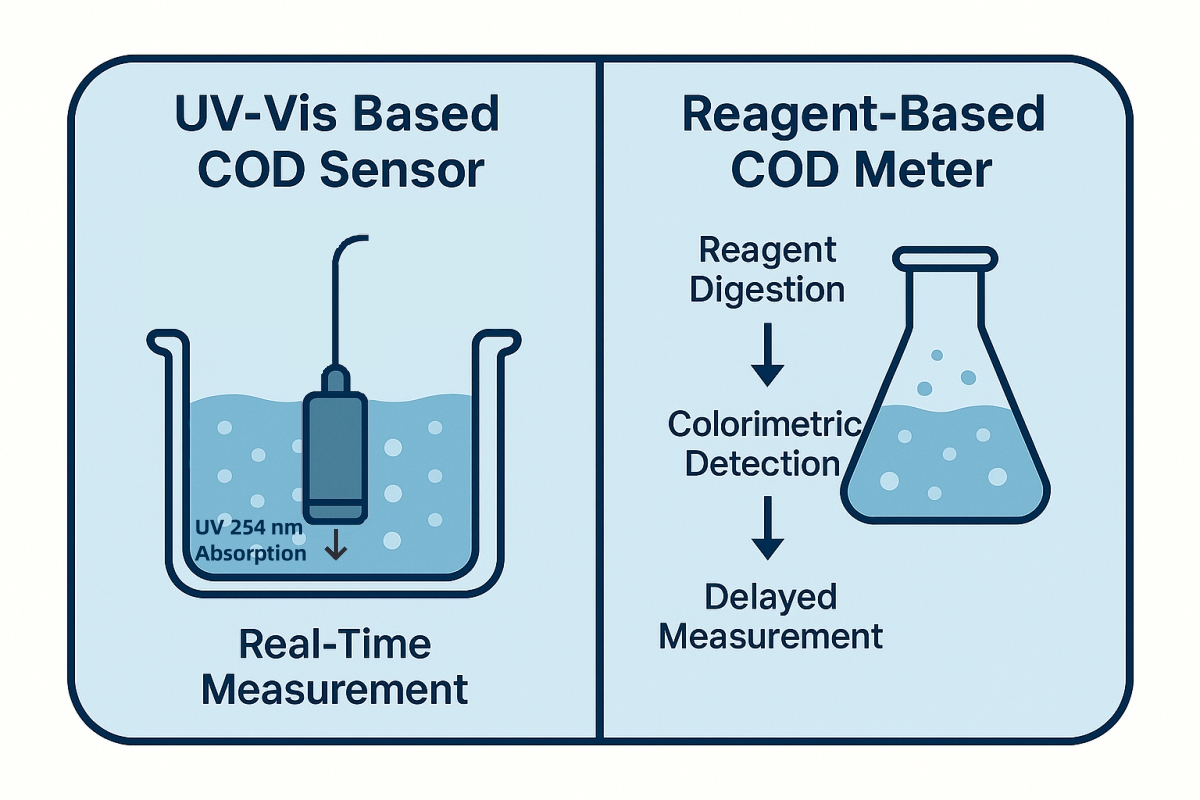
In contrast, reagent-based COD meters rely on chemical oxidation using strong reagents such as potassium dichromate under acidic conditions. The sample is digested at high temperature, and the resulting colorimetric change is measured to determine COD concentration. This traditional method is widely accepted for its accuracy but involves hazardous chemicals and time-consuming procedures.
Performance and Application Suitability
UV-Vis COD sensors provide rapid response times and are ideal for continuous monitoring in wastewater treatment plants, industrial discharge lines, and smart water systems. They require minimal maintenance and eliminate the need for chemical handling, making them more environmentally friendly and safer for operators.
Reagent-based COD meters, although highly accurate, are more suitable for laboratory testing or periodic field analysis. The digestion process takes between 1 to 2 hours and requires strict handling of toxic reagents, which can raise operational costs and safety concerns.
Comparison Summary
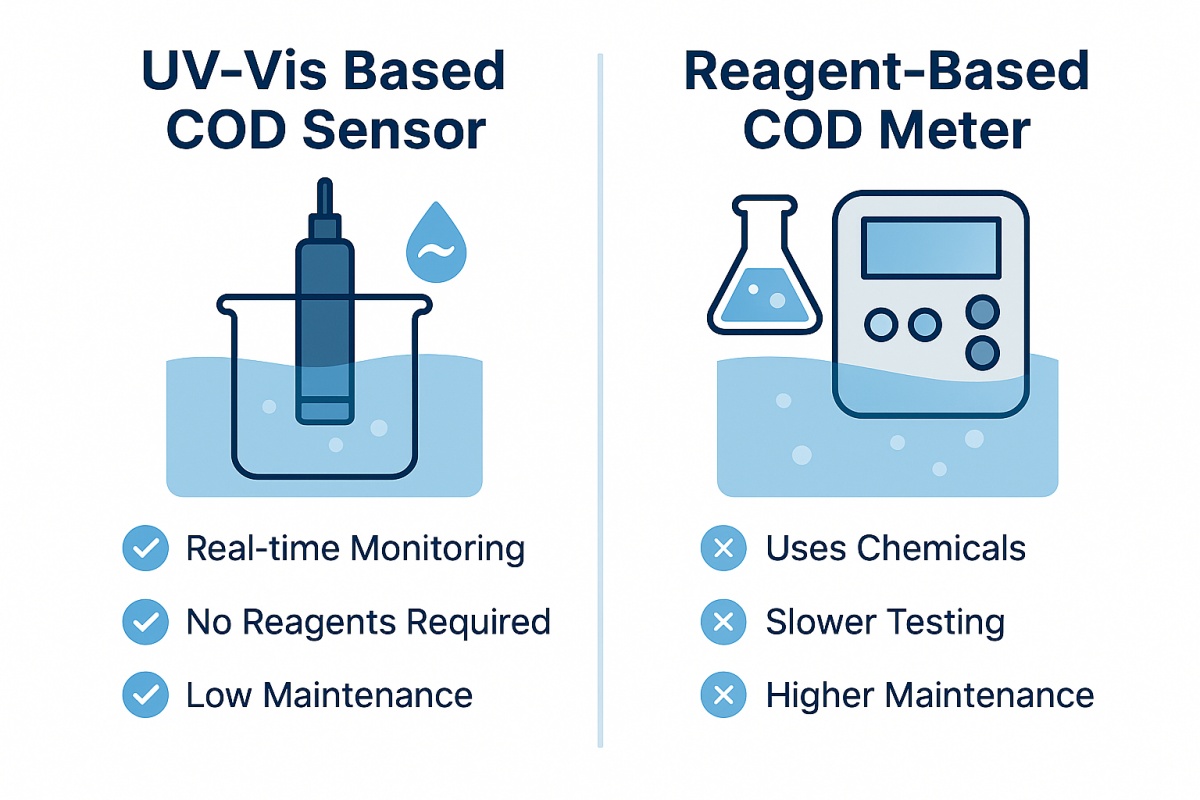
- Response Time: UV-Vis sensors provide near real-time readings; reagent-based meters require long digestion times.
- Maintenance: UV-Vis sensors are low-maintenance and automated; reagent systems require frequent calibration and reagent replacement.
- Environmental Impact: UV-Vis systems avoid chemical waste; reagent-based systems generate hazardous by-products.
- Suitability: UV-Vis is ideal for inline, real-time monitoring; reagent methods are better for lab-grade precision.
Conclusion
Both UV-Vis COD sensors and reagent-based COD meters serve critical roles in water quality monitoring. For real-time, low-maintenance, and eco-friendly operations, UV-Vis based COD sensors are the preferred choice in modern industrial and municipal applications. Reagent-based COD meters remain useful for compliance testing and laboratory validation.
Daruifuno offers a reliable line of UV-Vis COD sensors designed for continuous water quality measurement with excellent accuracy and stability. Our products support OEM and customized solutions for various industries. Visit our COD Sensor category page to explore more.
