

Introduction
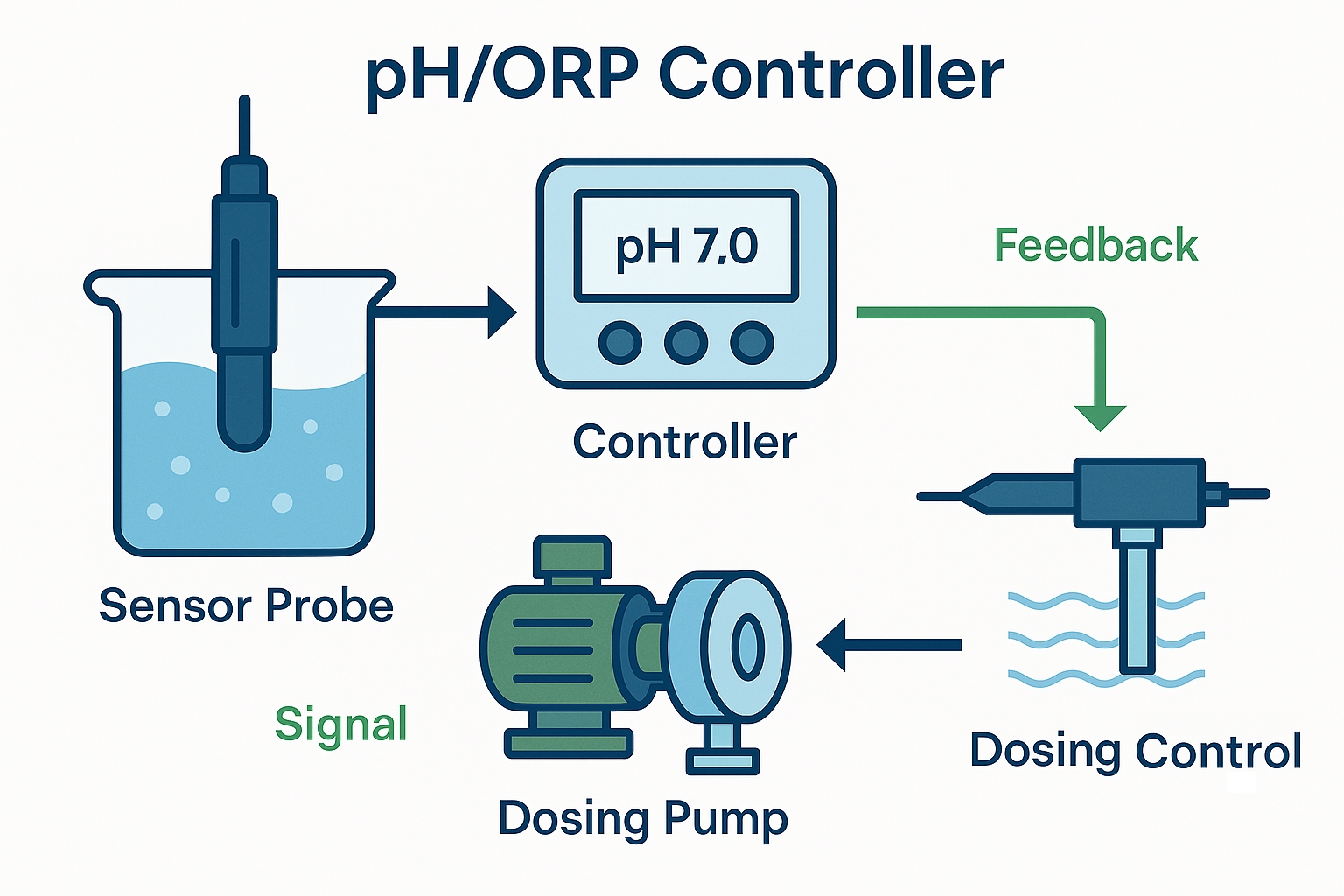
A pH/ORP controller is a critical device in water treatment systems, aquaculture, and industrial processes, designed to continuously monitor and maintain the pH or oxidation-reduction potential (ORP) of a solution within desired ranges. By automating the regulation of chemical dosing, it ensures process stability and water quality safety.
Key Components
Sensor Probe
Installed in the solution, it measures pH or ORP values in real time and converts the data into electrical signals transmitted to the controller.
Sensor types include glass electrodes (for pH) and platinum/gold electrodes (for ORP), requiring regular calibration to ensure accuracy.
Controller
Receives signals from the sensor and displays the measured values (e.g., pH 7.0 or ORP +300 mV).
Allows users to preset upper and lower thresholds for pH/ORP and includes alarm functions (e.g., audible/visual alerts).
Dosing Pump
Automatically activated by the controller to inject acid/base regulators (e.g., hydrochloric acid, sodium hydroxide) or redox agents (e.g., chlorine, sodium sulfite) into the solution.
Pump types include peristaltic pumps and diaphragm pumps, which must be compatible with the chemical properties of the dosing agents.
Control Process
Real-Time Monitoring
The sensor continuously collects solution data and transmits it to the controller via cable or wireless communication.
Threshold Comparison
The controller compares the measured values with preset thresholds. If values exceed the range (e.g., pH > 8.5 or ORP < -200 mV), it triggers the dosing pump.
Automatic Adjustment
The dosing pump injects chemicals at preset doses until the solution’s pH/ORP returns to the target range.
The system employs closed-loop feedback to dynamically adjust dosing amounts, preventing overdosing or underdosing.
Data Logging and Optimization
The controller stores historical data and supports trend analysis to optimize dosing strategies.
Application Benefits
Water Quality Stability
Maintains pH 6.5–8.5 in aquaculture to prevent fish stress; controls ORP > 650 mV in swimming pools to inhibit microbial growth.
Automation and Efficiency
Replaces manual intermittent dosing, reduces human errors, and minimizes chemical waste.
Real-Time Responsiveness
Millisecond-level sensor response and second-level controller decision-making ensure rapid handling of sudden anomalies (e.g., pH drops due to rainfall).
Compliance and Safety
Adheres to environmental discharge standards, reduces chemical leakage risks, and ensures operator safety.
Conclusion
The pH/ORP controller achieves precise and automated regulation of water quality parameters through the collaboration of sensors, controllers, and dosing pumps. Its applications enhance the operational efficiency of industrial and civil systems while providing reliable safeguards for sensitive environments (e.g., aquaculture, medical water). With the advancement of IoT technology, future controllers will integrate remote monitoring and intelligent diagnostics, driving the water treatment industry toward digitization and intelligence.
